

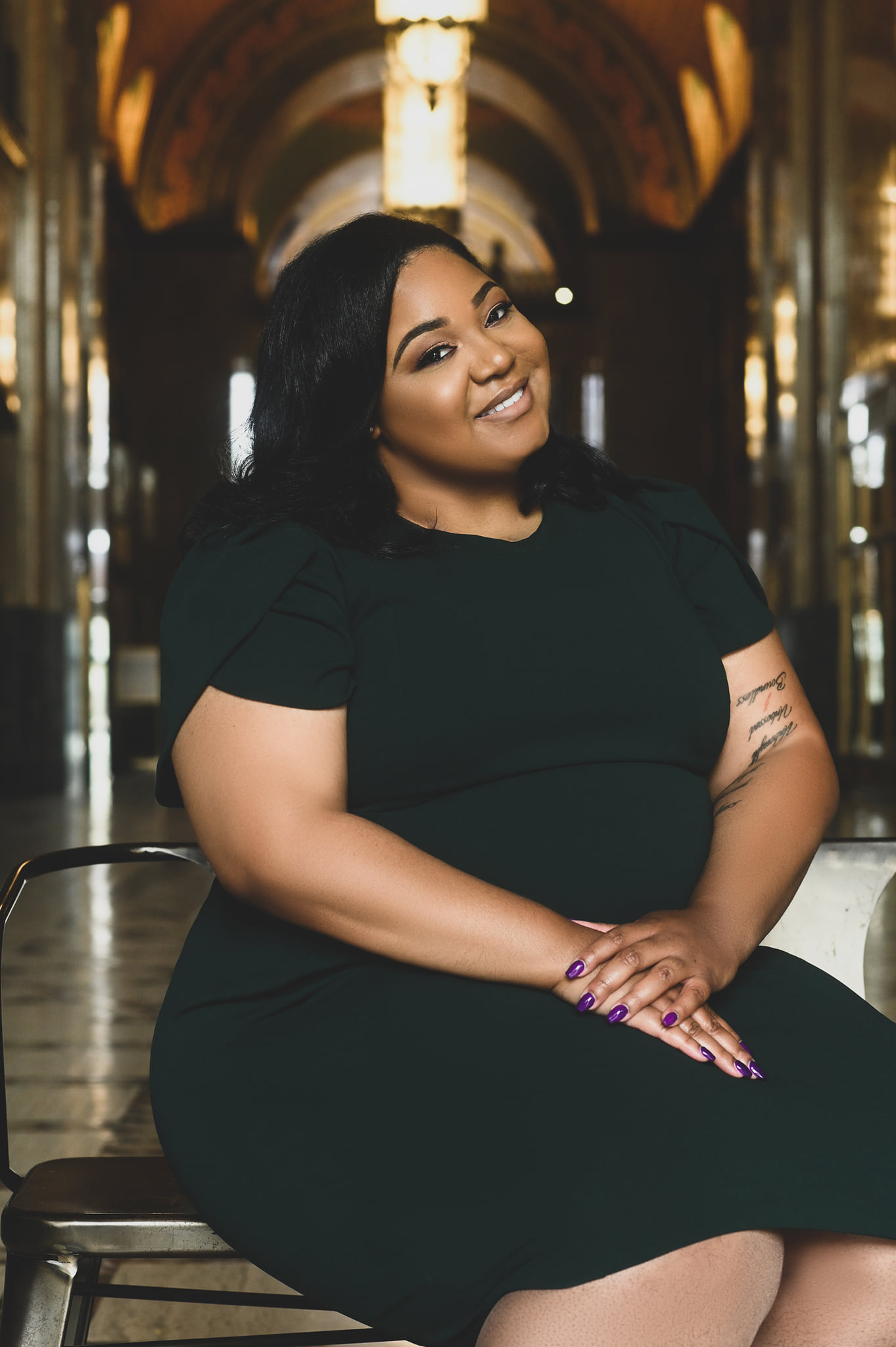
By Tiffany Brockington, 4th Episcopal District
A few weeks ago, I casually attended the 2026 WMS Executive Board and Leadership Training Institute in Baltimore, Maryland. Originally, I intended to drop off my mother and continue with my existing obligations. What should have taken less than thirty minutes became an hour and a half.
In approximately ninety minutes, I remembered several things:
- I have not attended a Connectional WMS meeting since 2015.
- I have not attended a Conference-level WMS meeting since 2019.
And then, I remembered why.
I am a third-generation member of the African Methodist Episcopal Church, specifically St. Stephen AME Church in Detroit, Michigan. My member number is not original to me. It belonged to my grandmother, Jeannette. She passed away the same year I officially affirmed my baptism and joined the Church. I am also a third-generation member of the Women’s Missionary Society.
My grandmother, Jeannette, was a Sarah Allen Torchlighter. In the Fourth District, a Sarah Allen Torchlighter is a member of the Women’s Missionary Society who has served extensively through the Conference level and does not serve beyond that level. My grandmother served as West Detroit Area Young Peoples Division (YPD) Director and later as Michigan Conference YPD Director. My Godmother, Jan, is a Life Member who has served on all levels for longer than I have been alive. Most notably, she was my mother’s Conference YPD Director.
My mother, Rosita, was a YPDer through the entire life cycle and served on every level in proper succession. She became an OPDer in her mid-twenties upon completing her Quadrennial appointment as Connectional YPD Recording Secretary. She transitioned seamlessly into the Society and continued to serve in the same manner – again, in proper succession. Today, she serves as Michigan Conference Branch WMS President and is the youngest Life Member in the Conference, and possibly in the Fourth District.
I was a YPDer from the very beginning until becoming an OPDer in 2011, upon graduating from high school. I served on the local, area, and conference levels. I never sought or held the office of President during those years because my mother was the Michigan Conference YPD Director, and she consistently stressed the importance of recognizing power and privilege, and of avoiding the consolidation of influence within one family, one church, and one area. There was never a question about attendance. If my mother attended, so did I.
I became an OPDer earlier than most because there was no remaining pathway for me to continue as a YPDer in the Fourth District at that time. Shortly thereafter, I left for Howard University. During undergrad, I faithfully attended Ebenezer AME Church in Fort Washington, Maryland, and participated in the Alice Marie Chapman Women’s Missionary Society. It was there that I realized how differently missionary life functioned in the Second District compared to the Fourth.
From 2011 through early 2015, I was not formally active in the Society. I understood that I was within the Young Adult Missionary category, but at home, I remained among the youngest.
In March 2015, Dr. Shirley Cason-Reed served as our Missionary Sunday speaker. Over dinner, I mentioned that I was not an official Missionary. She looked genuinely concerned and asked why. I explained that I felt “too young” and had transitioned from YPD early. She asked my age. I had just turned twenty-two.
She replied, “I switched from YPD to WMS at eighteen.”
She invited me to join the Society that evening. I said yes. She then asked if I would serve as her Page for the 2015 Quadrennial. Again, I said yes. She removed the WMS pin she was wearing and handed it to me, telling me she would formally pin me at Quadrennial.
She made space for me because it made sense to do so.
Between 2015 and 2019, I served on the local, conference, and district levels. In 2017, I submitted my candidacy to become Michigan Conference Branch YPD Director. I was qualified, and my paperwork was properly submitted. At the Annual Conference, I was told that I was “too young” and that another Missionary would be preferred. I was asked instead to serve as Conference Scholarship Coordinator. I accepted.
In 2019, I ran for Delegate to the next Quadrennial. I was the youngest candidate. The voting body anticipated that I would withdraw so that a unanimous ballot could be passed. I did not withdraw. Several elder missionaries approached me privately and asked that I reconsider. I declined. (My mother did not ask that of me. She supported my decision.)
As the election process unfolded, requiring an actual vote rather than a unanimous ballot, some missionaries responded not with procedural clarity but with public criticism directed specifically at me. I was publicly chastised for standing. The tone suggested that my mere decision to exercise my right to run was inappropriate.
When the vote concluded, and I was neither elected Delegate nor Alternate, I requested permission to address the body. I was granted that permission. I expressed that my disappointment was not with the election’s outcome but with the manner of engagement. I reminded the body that our Constitution and Bylaws exist to be applied equally to all members. I asked those present to look around the room and count how many Young Adult Missionaries were there. There was one other.
That was the last meeting I attended.
I returned to the WMS Leadership Training Institute (LTI) in 2026 because an elder who once served as my YPD Director asked to see me. That afternoon, I sat at lunch with Missionaries older than my mother and listened as they discussed strategy and the work before them.
I know this Society because I was raised within it.
The same child who once sat on the floor at Annual Conference, spiral-binding booklets grew into the woman they later declined to elect and publicly chastised for standing.
The skills developed as a YPDer are not incidental. They are transferable. Leadership, governance literacy, procedural knowledge. These are skills I use daily in my professional life.
There are several realities worth naming. Some Missionaries were never YPDers, and without that experience, it may be difficult to envision how a Young Adult Missionary could lead effectively within the WMS. Some Missionaries acknowledge the Constitution and Bylaws in theory yet struggle to apply them consistently when doing so requires institutional adjustment.
If we believe we are raising children in the way they should go, then we must also make room for the adults they become. Refusal to make space does not halt growth immediately, but it does delay it in ways that compound over time.
I had a sobering realization. There is one other missionary in my conference who is a few years older than me, more than a decade younger than my mother, yet still older than me. She was a YPDer who served the entire life cycle on all levels, in proper succession and became an OPDer at age twenty-six. She transitioned into the Society and has continued to serve on all levels, again in proper succession. She has more than met the qualifications for life membership, yet she is not a Life Member. She has endured much of the same treatment that I have endured.
I began looking for who else would be her peer, who else would be eligible for Life Membership. I found no one. Then I pondered, who will come after her? I did not find anyone else but myself.
I realized that I have served on all levels of the Women’s Missionary Society for a decade. If I include my years of sustained activity at the local level, that span approaches fourteen years.
And this is a problem.




Thank you for your honesty, courage, and thoughtful witness. The questions you raise deserve careful consideration, and I am grateful you were willing to raise them.
Peace & Blesings
Rev.Tameaka Reid Sims
My Sisters, we must continue to encourage and support our young women. If opportunities are not always readily available, we must remind them that their calling is still valid.
Let us guide them to prepare, remain engaged, and stand ready to serve. At the same time, we must be intentional in creating space, providing mentorship, and opening doors for their growth.
We are not just leading for today, we are building for tomorrow.
My sister, you are valid and needed. Please do not stop sharing your gifts and talents. God will open doors to opportunities. That no one can close.
This is the sobering reality of the “politics” of the organization. The thing that I find “interesting” is that “they” always ask “where are the young people?” yet when the young people show up, they shut you up and sit you down. And its not just with the really younger people/younger women in their 20s. Its anyone that the powers that be of the organization feel is “younger”. They can be in their 80s, you can be in your 50s, and they want you to sit down. This is why people are getting up and sitting down at other churches and in other organizations where their gifts are appreciated and their presence is appreciated. And don’t feel bad: I am in my 50s. I recently attended my last meeting, for somewhat similar reasons. So be encouraged my young sister. And yes, I remember Sis. Rosita very well. God bless.
This was an absolutely beautiful and truthful story. Reflecting on my memories as a YPD’er and now serving as a missionary, it’s clear that this issue still exists today.
Excellent sobering realization for us all to concsider.