By Robert P. Jones, Ph.D., President and Founder, Public Religious Research Institute (PRRI)
Just ahead of Independence Day, PRRI released a large new survey taking the pulse of a divided nation just ahead of the celebration of our 250th anniversary. Alongside deep concerns about the nation, the survey shows that Americans overwhelmingly want a nation that embraces pluralism at home and behaves as a good global neighbor abroad.
Signs of Disillusionment and Distress
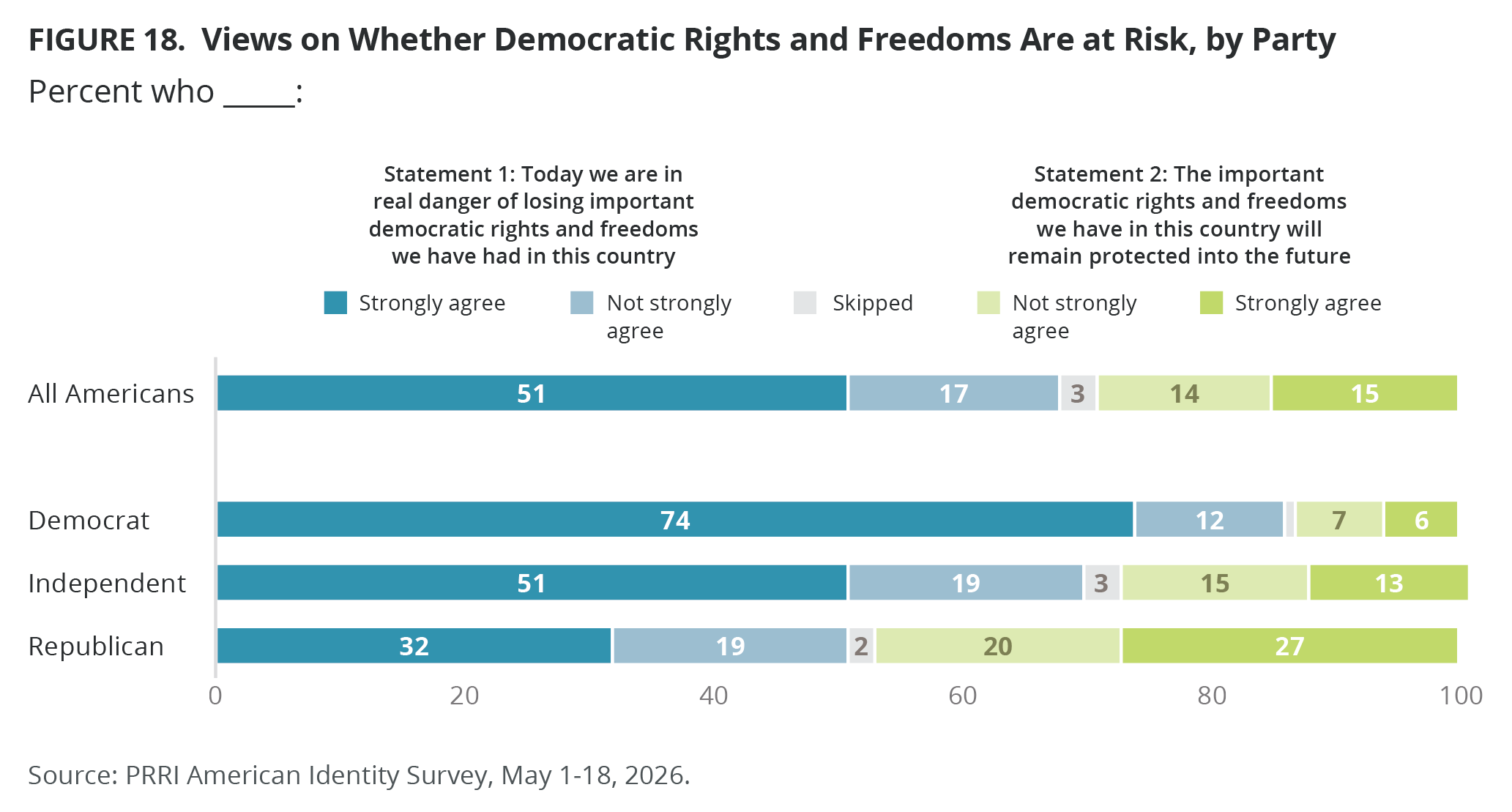
Asked to choose between two statements, Americans are more than twice as likely to agree that “we are in real danger of losing important democratic rights and freedoms” than to agree that “the important democratic rights and freedoms we have will remain protected” (68% vs. 29%). In a pattern that repeats itself throughout the survey, overwhelming numbers of Democrats (86%) and independents (70%) agree with the first statement, while Republicans are divided between the two statements (51% vs. 47%).
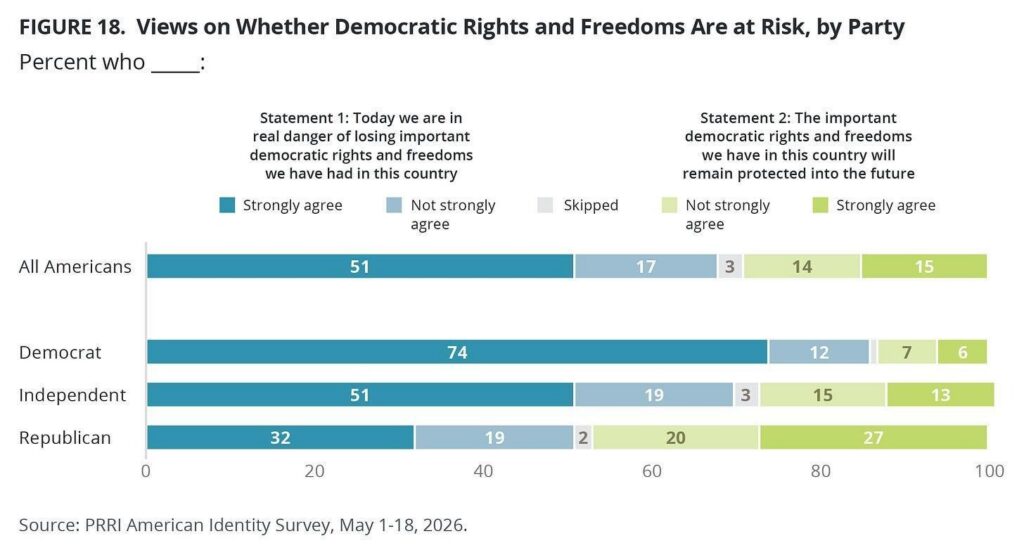
“The fact that nearly 7 in 10 Americans believe we are in danger of losing critical rights and freedoms should set off alarm bells,” remarked PRRI CEO Melissa Deckman at the survey’s release.
The partisan divides are even stronger over perceptions of Donald Trump. Trump’s favorability is down from 41% just two years ago to 34% among the general population. But even as Trump’s favorability is slipping among most subgroups, it remains strong among the MAGA base: 79% among Republicans and 67% among white evangelical Protestants.
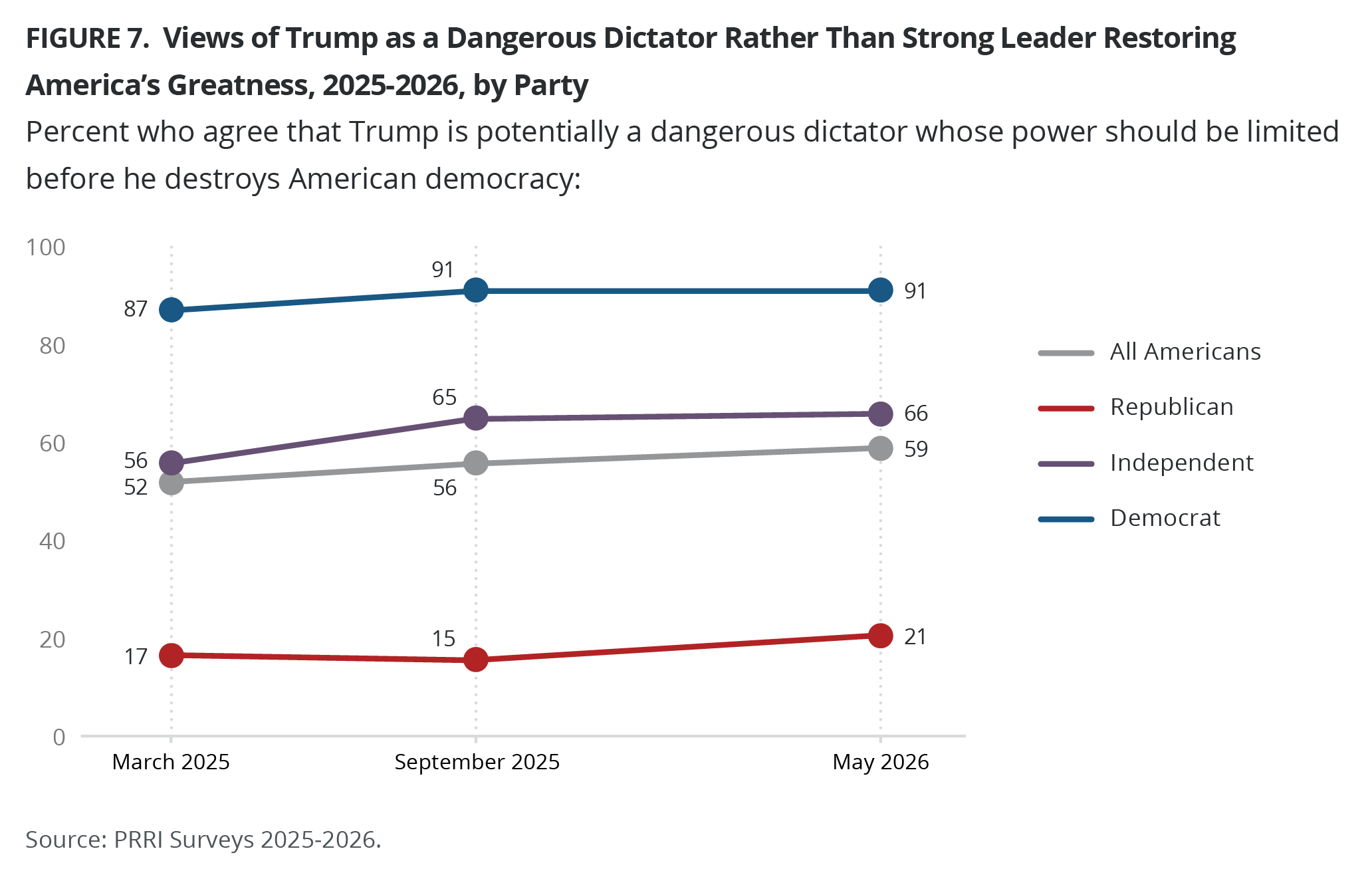
Notably, Americans are increasingly seeing Trump as a threat to democracy. When asked to choose between two statements, nearly 6 in 10 Americans agree that “President Trump is a dangerous dictator whose power should be limited before he destroys American democracy” (59%), up from 52% in March 2025, compared with 38% who agree “President Trump is a strong leader who should be given the power he needs to restore America’s greatness.” Most Democrats (91%, up from 87% in March 2025) and independents (66%, up from 56% in March 2025) agree with the first statement, while most Republicans agree with the second statement (78%, down from 81% in March 2025).
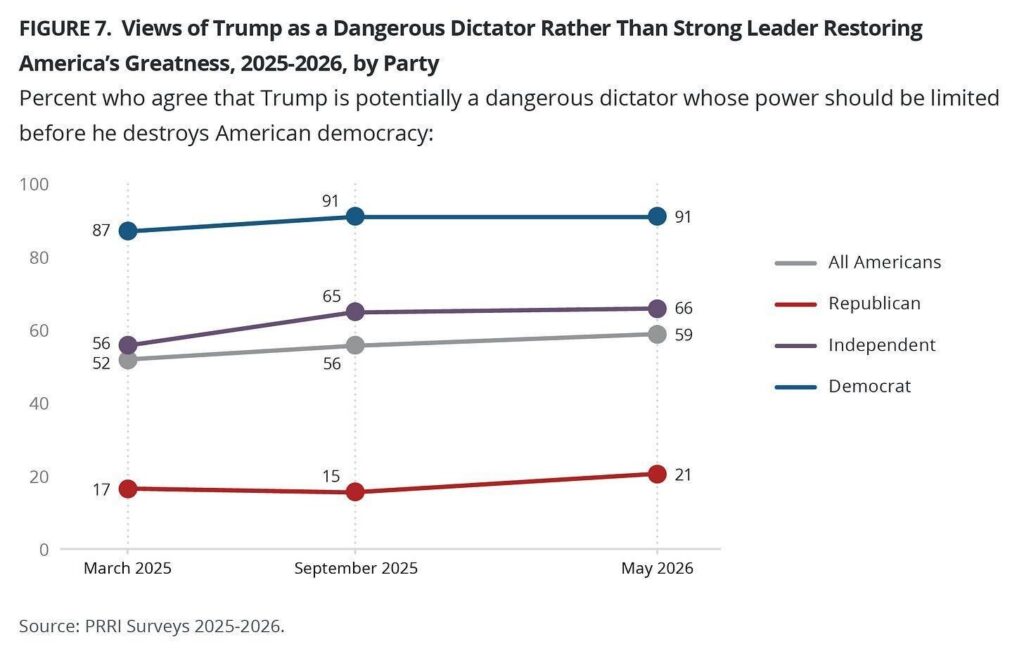
These partisan divides—with Democrats and independents perceiving one reality and Republicans decidedly perceiving another— represent a profound threat to the democratic experiment at 250.
The Country Most Americans Want:
A Pluralistic Democracy at Home and a Good Neighbor Nation Abroad
At home, most Americans reject the vision of America as a white Christian nation and remain committed to a vision of America that is religiously and racially diverse.
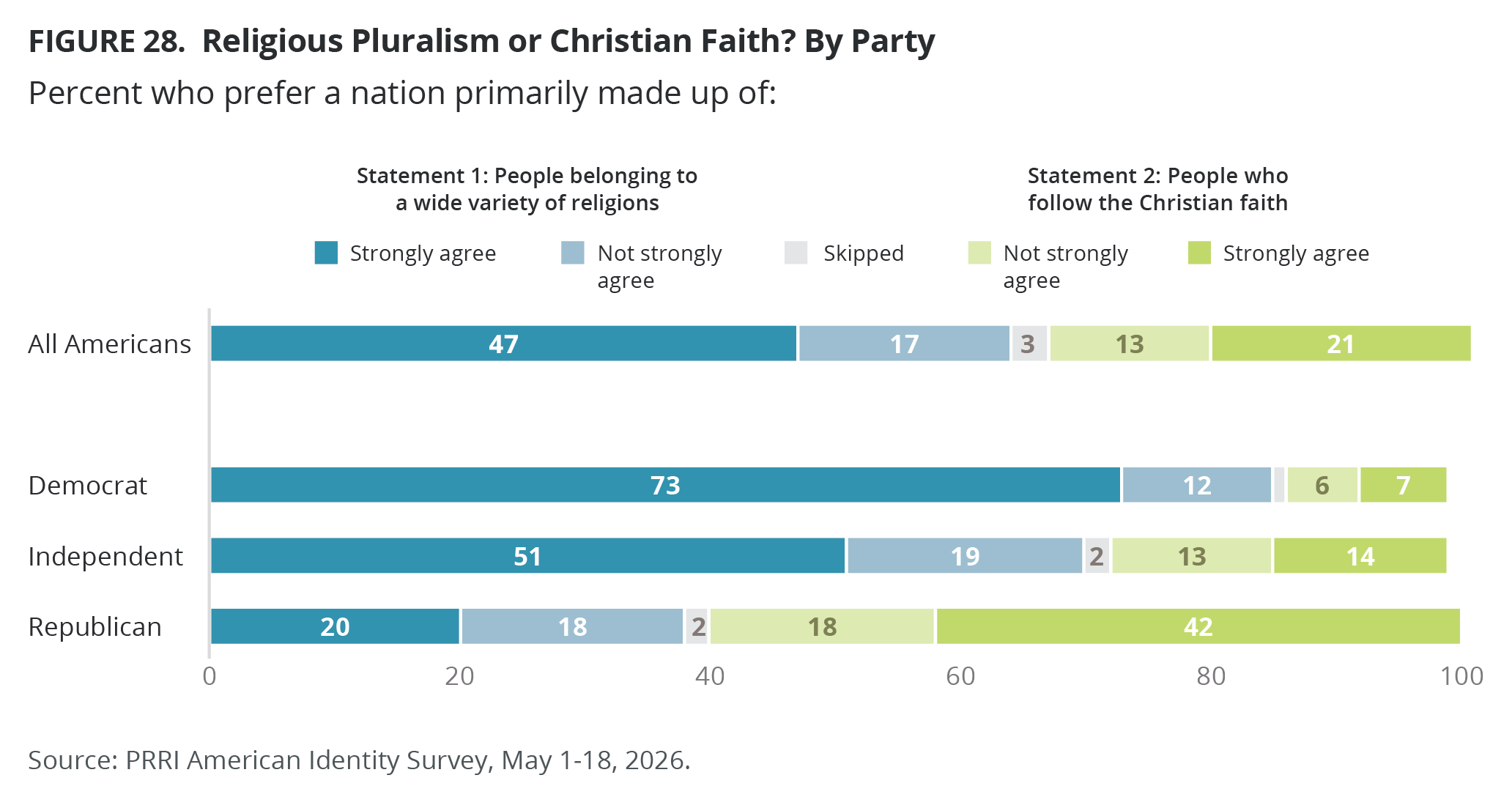
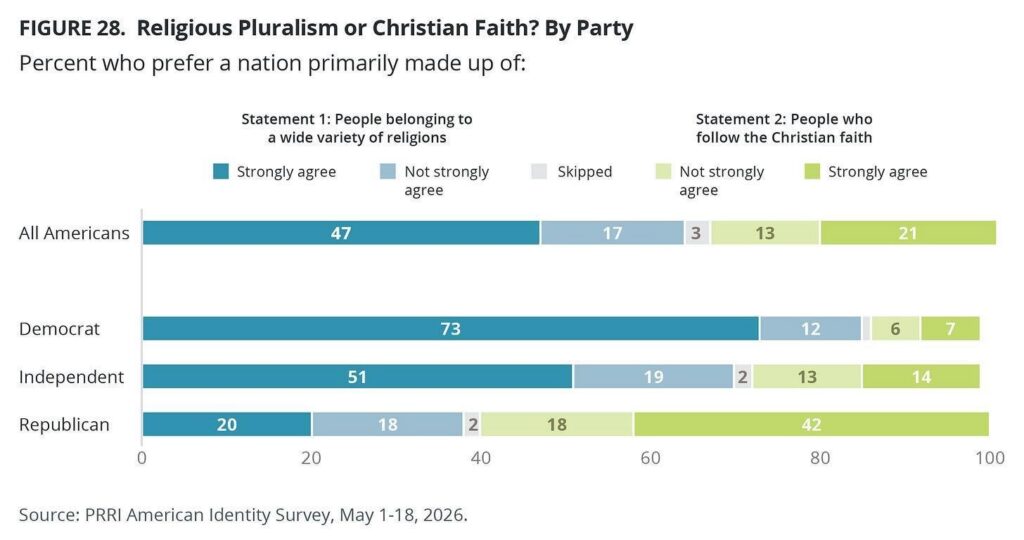
Nearly eight in ten Americans prefer the U.S. to be a nation made up of people from all over the world (77%) rather than one primarily made up of people of Western European heritage (20%). And nearly two-thirds of Americans prefer the U.S. to be a nation made up of people belonging to a wide variety of religions rather than one primarily made up of people who follow the Christian faith (64% vs. 34%). However, white evangelical Protestants and Republicans are outliers, preferring to live in a nation primarily made up of Christians (68% and 60%, respectively).
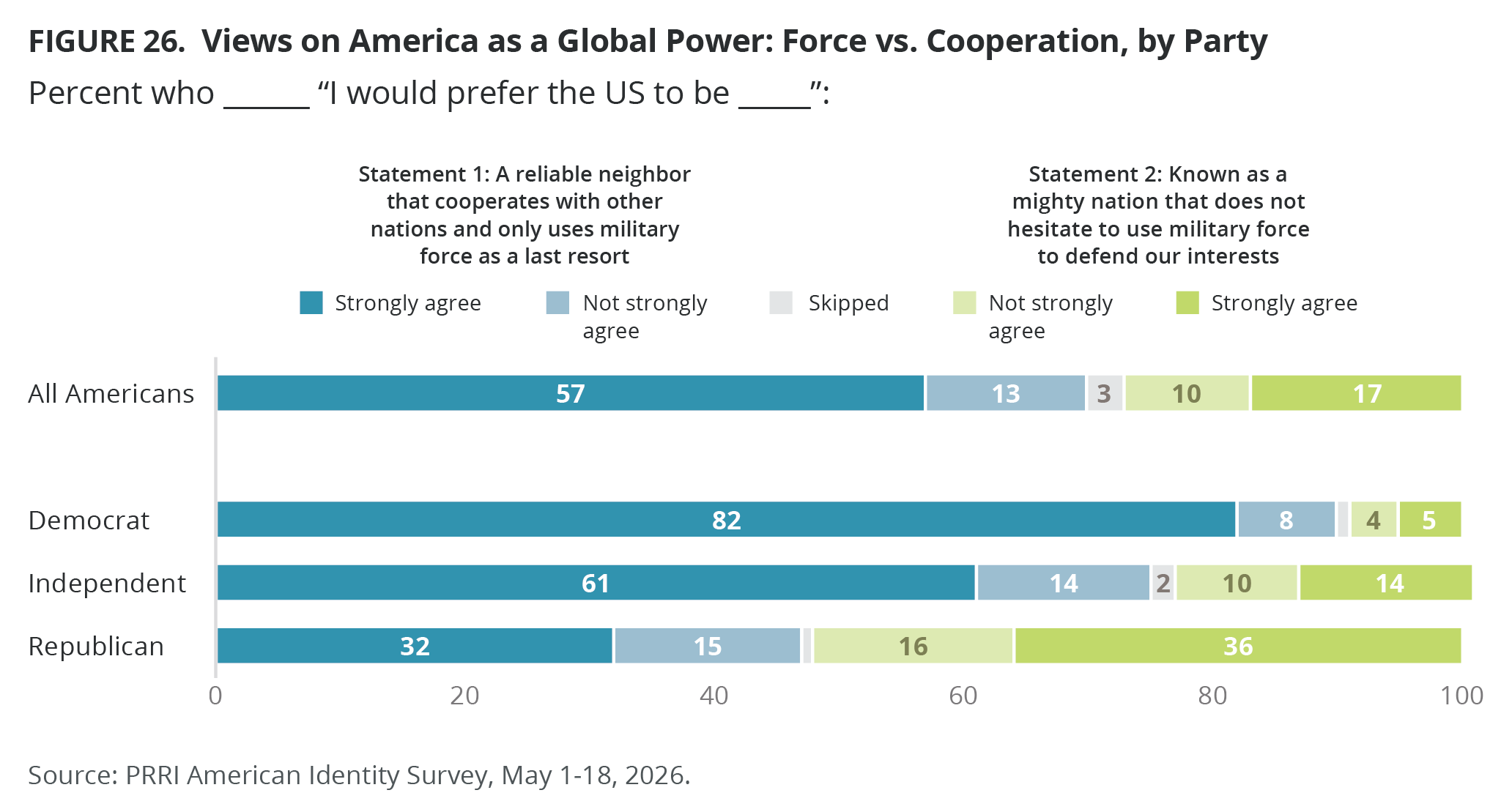
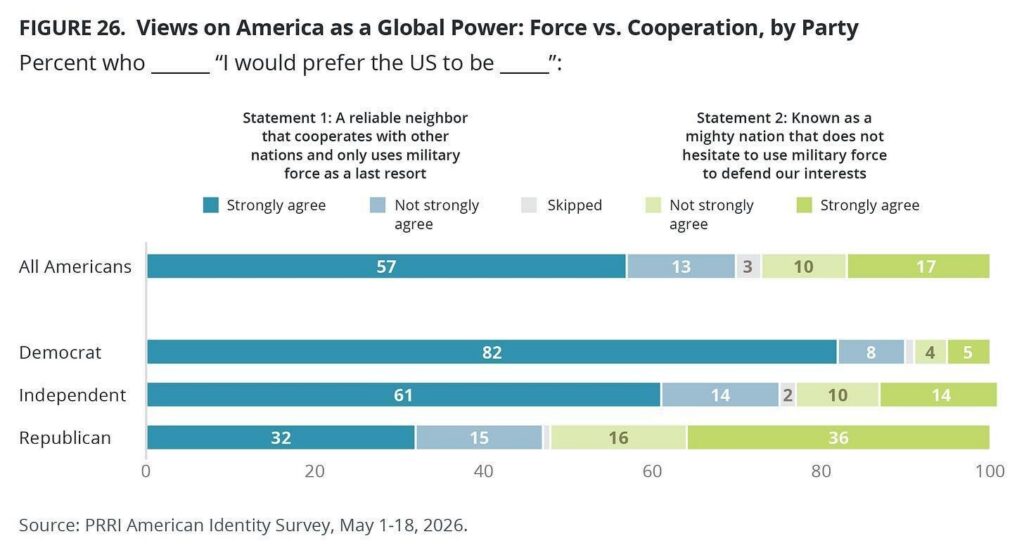
Abroad, Americans are far more likely to say they would prefer the U.S. “to be a reliable neighbor that cooperates with other nations and only uses military force as a last resort” than “to be known as a mighty nation that does not hesitate to use military force to defend our interests” (70% vs. 27%). However, slim majorities of white evangelical Protestants (52%) and Republicans (52%) agree with the second statement. Solid majorities of both independents (75%) and Democrats (90%), as well as all other major religious groups, prefer the U.S. to cooperate with other nations.
As we near a time of reflection precipitated by the observance of our nation’s 250th anniversary, there are clear signs of disillusionment and distress. The nation is deeply divided along lines of party, race, and religion. Indeed, our partisan divides are now expressions of our racial and religious divides, with the Republican Party increasingly becoming the party of conservative white Christians (self-identified Republicans are 68% white and Christian in a country that is 40% white and Christian) and Christian nationalist ideology.
But the survey also generates some hopeful light. Most Americans still embrace—as Abraham Lincoln eloquently put it in his first inaugural address to his fellow citizens standing on the brink of a civil war—“the better angels of our nature.” Even amid the disorienting fog produced by the MAGA machine, more of us, and hopefully enough of us, are still keeping our eyes fixed on the unfulfilled promise of becoming a truly pluralistic democracy.