By Robert P. Jones, PRRI
I’ve spent the last two decades as a Christian participating with my Jewish spouse in the Jewish High Holidays, which mark the end of one year and the beginning of the next. My status as an outsider, I’ve come to realize, means that while I’ll never experience the deep resonance these Days of Awe have for my spouse, my “beginner’s mind” allows me to find overlooked significance in what seems obvious to others.
This year, I’ve been struck by how we divide a continuous stream of experience into manageable chunks to make meaning. We humans are categorical creatures in a continuous world.
For those of us observing Jewish holidays, the slipperiness of the Jewish lunisolar calendar relative to the official national solar Gregorian calendar is a constant reminder of this fact. Although it was lost on me growing up, the complicated calculations determining the date of Easter—and the different dates observed by Catholic and Protestant Christians on the one hand and Orthodox Christians on the other—is also a result of the dance between older lunisolar and newer solar calendars.
Even the more frequent transitions reveal our attempts to draw what are, upon even simple examination, arbitrary demarcation lines. Jewish holidays, for example, start at sundown the evening before the day they are observed. But while we all have an intuitive sense of “day” and “night” as separate things, finding that moment when one becomes the other is vexingly elusive.
Not surprisingly, there has been considerable historical debate about the nature of sunset in Jewish tradition, particularly over the liminal period between sunset and the appearance of stars, known as bein hashemashot (literally “between the suns”). Some rabbis argued that the significant moment was when the last edge of the top of the sun slipped below the horizon. Others argued there was a second sunset when the first stars became clearly visible. Today, many strictly observant and Orthodox Jews rely on printed calendars with precise times for each day, but even these have to be adjusted for geographic location. And some, just to be sure, allow a 40- to 50-minute buffer zone before declaring the line has been safely crossed.
These High Holidays reflections have also made me realize how difficult it is for all of us, as humans, to know when we’ve passed from one thing into another. It’s at the root of some of our fiercest policy debates. When does life begin, and when does it end? It’s inescapable in our relationships, where it not only defines others but our own identity in relation to them. When do our children pass from being infants to toddlers to children to teens to adults? When does friendship cross into romance? Faithfulness into betrayal? How do we arrive at forgiveness?
Last fall, my colleagues at The Convocation (Diana Butler Bass, Kristin Du Mez, and Jemar Tisby) teamed up to do a series of “Faith and Democracy Tour” events. Responding to a question about the likely attacks on democracy that would come in the wake of a potential second Donald Trump presidency, I was struggling to think about how we might responsibly respond. I didn’t have any specifics to offer. But this response came to me in the moment: Look for the bright lines.
As I’m writing this following this time of solemn reflection, repentance, and renewed commitment, I’m painfully aware of how many bright lines have been crossed in just eight months since Trump’s return to power—too many to attempt to name here. And as I’ve been speaking to a variety of audiences, I’m also aware that most Americans remain unaware that we can now view most of those bright lines only in the rear-view mirror.
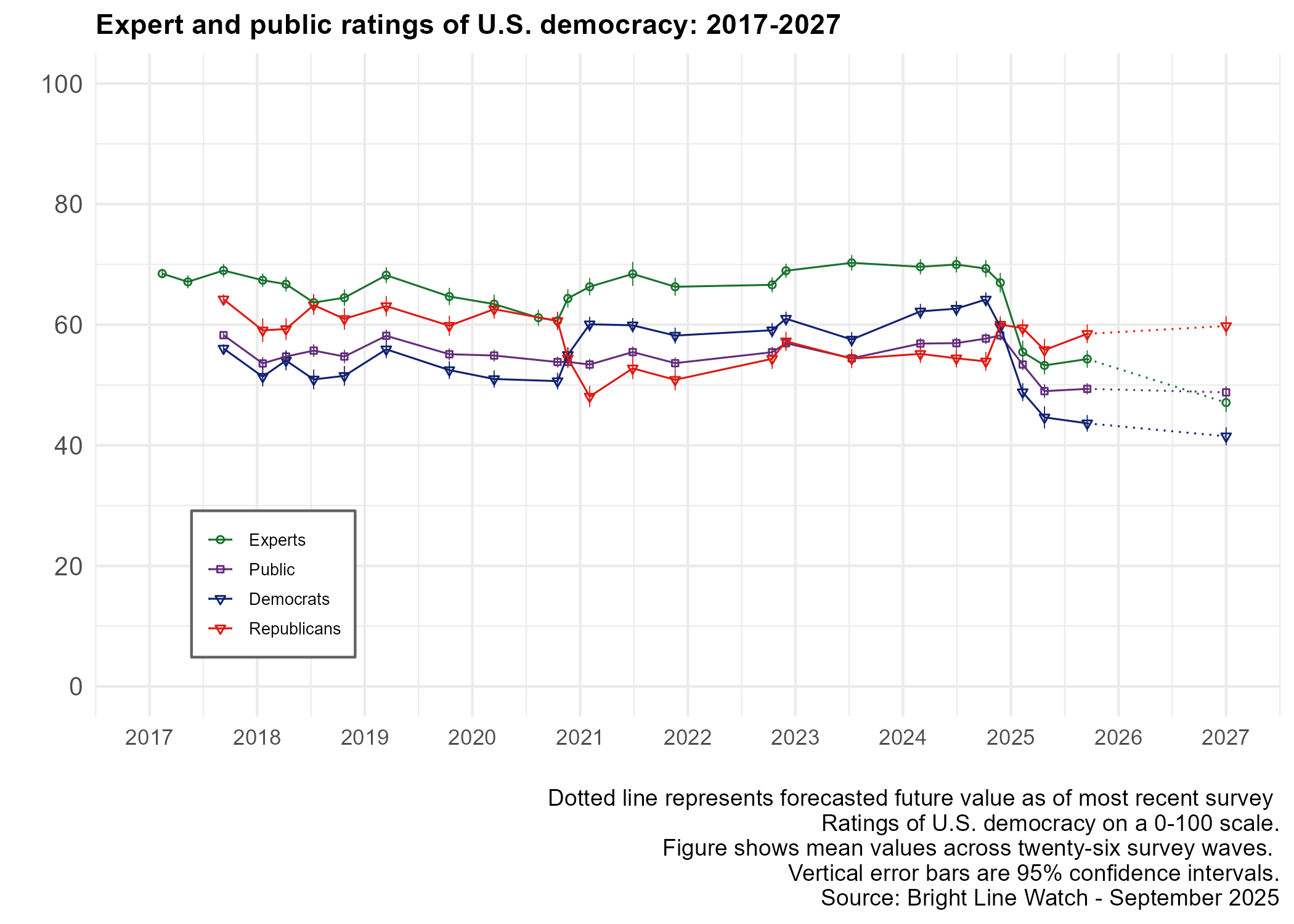
But you don’t have to take my word for it. This week, a new “Bright Line Watch” survey of over 700 leading American political scientists found that their rating of the U.S. as a functioning liberal democracy fell precipitously since Trump took office in January. Between the first Bright Line Watch survey in 2017 and 2024, which notably included Trump’s first term, the experts had rated the U.S. generally in the high 60s on a scale from 0 (complete dictatorship) to 100 (perfect democracy). As recently as the 2024 election, experts had given the U.S. a rating of 67.
In response to Trump’s authoritarian actions after taking office, experts’ rating of the U.S. as a democracy in the Bright Line Watch Survey fell from 67 out of 100 before the election to 55 in February and to 54 in September. Experts also now project that the U.S. democracy rating will drop further to 47 by 2027.
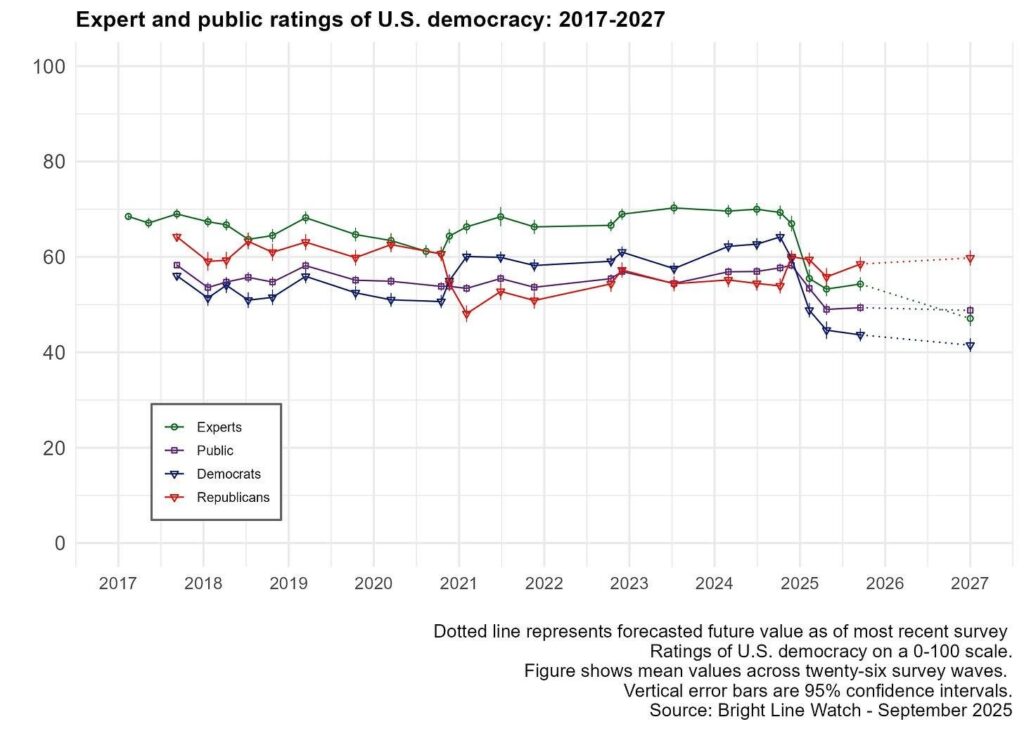
To put those numbers into perspective, our current rating of 54 puts the U.S. below experts’ ratings of democracy in Mexico and Poland; the projected rating of 47 puts the U.S. on par with experts’ current rating of Israel and in the neighborhood of experts’ 2022 ratings of Brazil and the Philippines.
The areas in which experts expressed the most serious decline in confidence between April and September were notably:
- toleration of peaceful protest (from 49% in April 2025 to 38% in September 2025);
- not using government agencies to punish political opponents (from 15% to 7%); and
- unbiased election district boundaries (from 8% to 3%).
- Additionally, after Charlie Kirk’s assassination, experts’ confidence in the government effectively preventing political violence or intimidation fell from 52% to 29%.
The Bright Line Watch report (I encourage everyone to read the full findings) summarizes the implications of the study with this stark assessment: “Current expert ratings of U.S. democracy are closer to those of a mixed or illiberal democracy than a full democracy or countries often considered as relevant comparisons such as Great Britain and Canada.”
In How Democracies Die, Harvard political scientists Steven Levitsky and Daniel Ziblatt emphasized the challenging gradual nature of the slide from democracy to authoritarianism. “Democracy no longer ends with a bang—in a revolution or military coup,” they write, “but with a whimper: the slow, steady weakening of critical institutions, such as the judiciary and the press, and the gradual erosion of long-standing political norms.”
Because democracy gradually slips, rather than implodes, it’s often hard to name its loss prior to its disappearance. Taking a cue from the rabbinical debates, I’d argue that we’ve now entered that liminal period of bein hashemashot. The last top crescent of our liberal democracy has slipped below the horizon. But there is still time to act before the darkness fully overtakes us.
Robert P. Jones, Ph.D., is the President and Founder of PRRI. He is the author of The Hidden Roots of White Supremacy and the Path to a Shared American Future, a New York Times bestseller, White Too Long: The Legacy of White Supremacy in American Christianity, winner of a 2021 American Book Award, The End of White Christian America, winner of the 2019 Grawemeyer Award in Religion Writing Weekly at WhiteTooLong.net.